Collection No. 1 · August 2026 · Now showing

Held Force

Eight consecutive days of studies in pressure that chooses its own stopping point, each built from the construction method of a different Japanese master.
For eight consecutive days at the start of August I studied a different Japanese master each morning — Yoshitoshi, Hiroshige, Sesshū, Kōrin, Utamaro, Tōhaku, Kuniyoshi, Hokusai — not to copy their images but to borrow their construction: how a hooked arc is opposed by a rigid diagonal, how a foreground can be too large to understand, how emptiness is made to carry weight. Each study transformed that construction into an original artifact of torn paper, ink, and mineral pigment.

What the eight days turned out to share, I only saw at the end: every one of them is about force that stays under exact control. A leap that never lands. A climb that keeps going. A lattice that stops where it is told. A fist that folds instead of closing. The sequence runs in the order the works were made, because the order is part of the record — restraint practiced daily, not arrived at once.

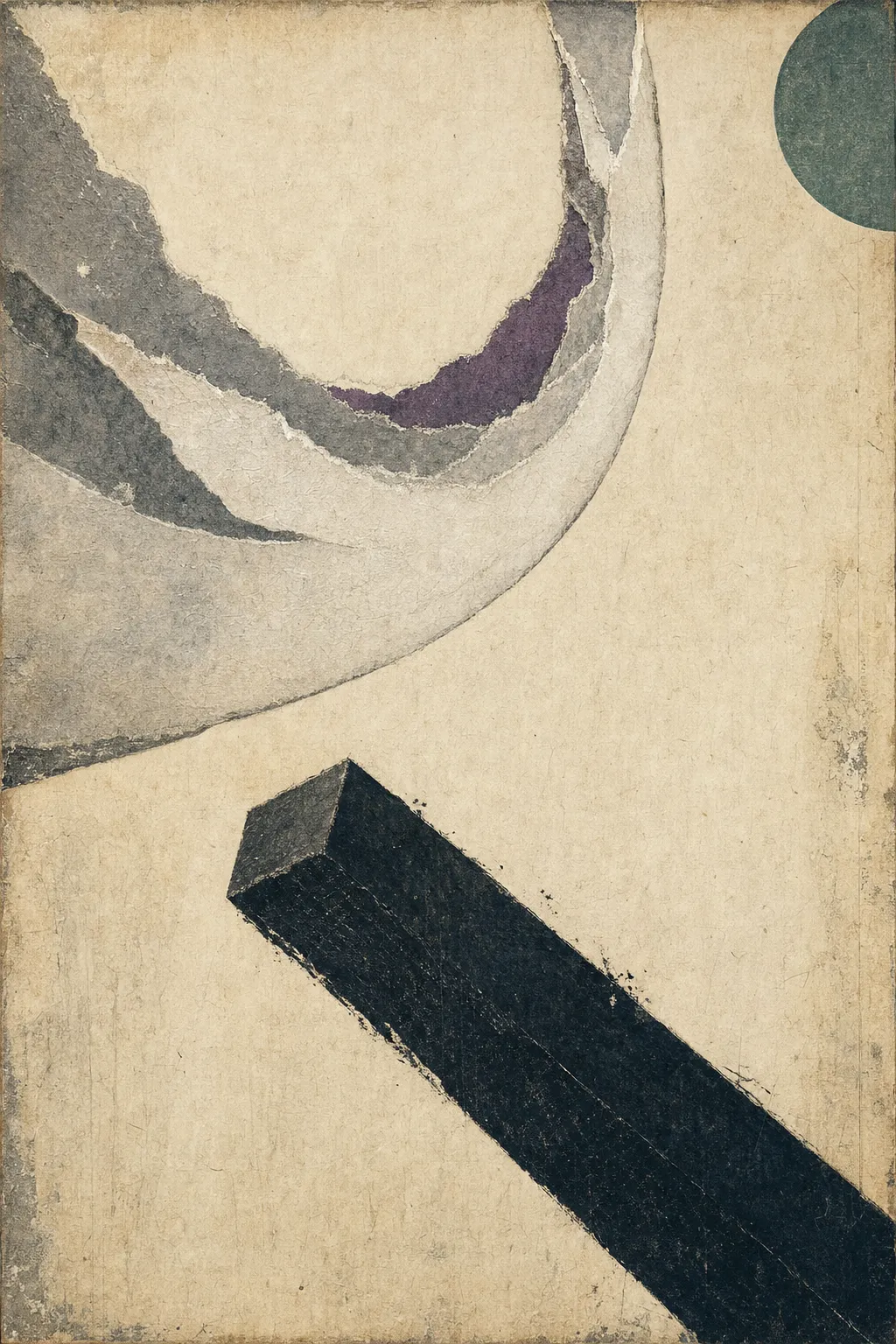
  1. Tall composition on cream washi. A large crescent of torn gray and chalk-white paper arcs across the upper left, hooking upward out of frame; its inner curve is lined with deep plum. A matte black rectangular beam rises on a hard diagonal from the lower edge toward the crescent without touching it, and a small dark teal circle sits partially cropped at the upper right. Wide bare paper separates the two forms.
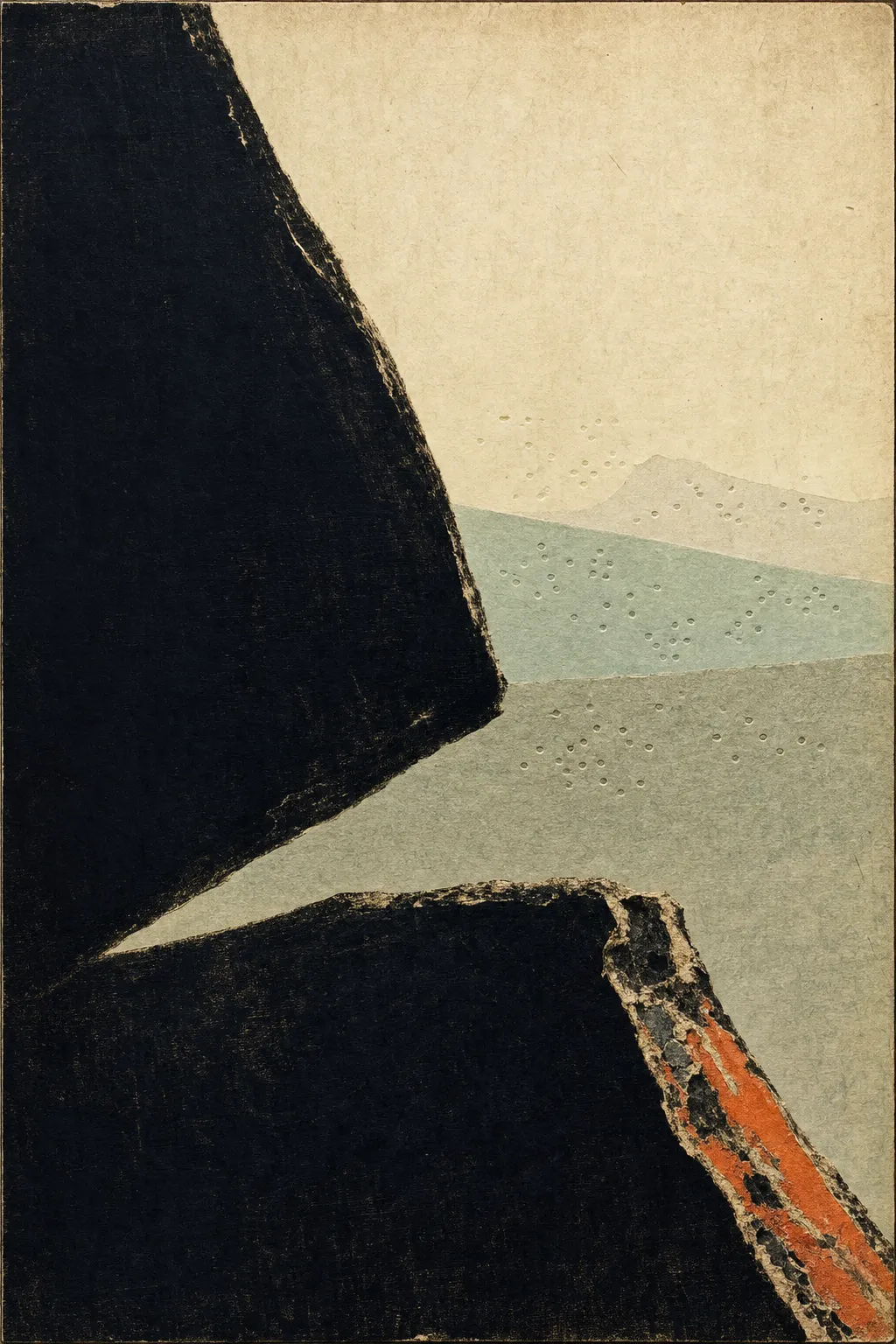
  2. Tall composition. Two colossal near-black forms with the dry texture of inked wood enter from the left and bottom, forking apart mid-sheet to leave a narrow opening. Through the fork, three pale planes step back in flat celadon-gray bands scattered with small punched dimples, under a warm cream sky with a faint ghosted ridge. The torn edge of the lower black form exposes a seam of ember orange.
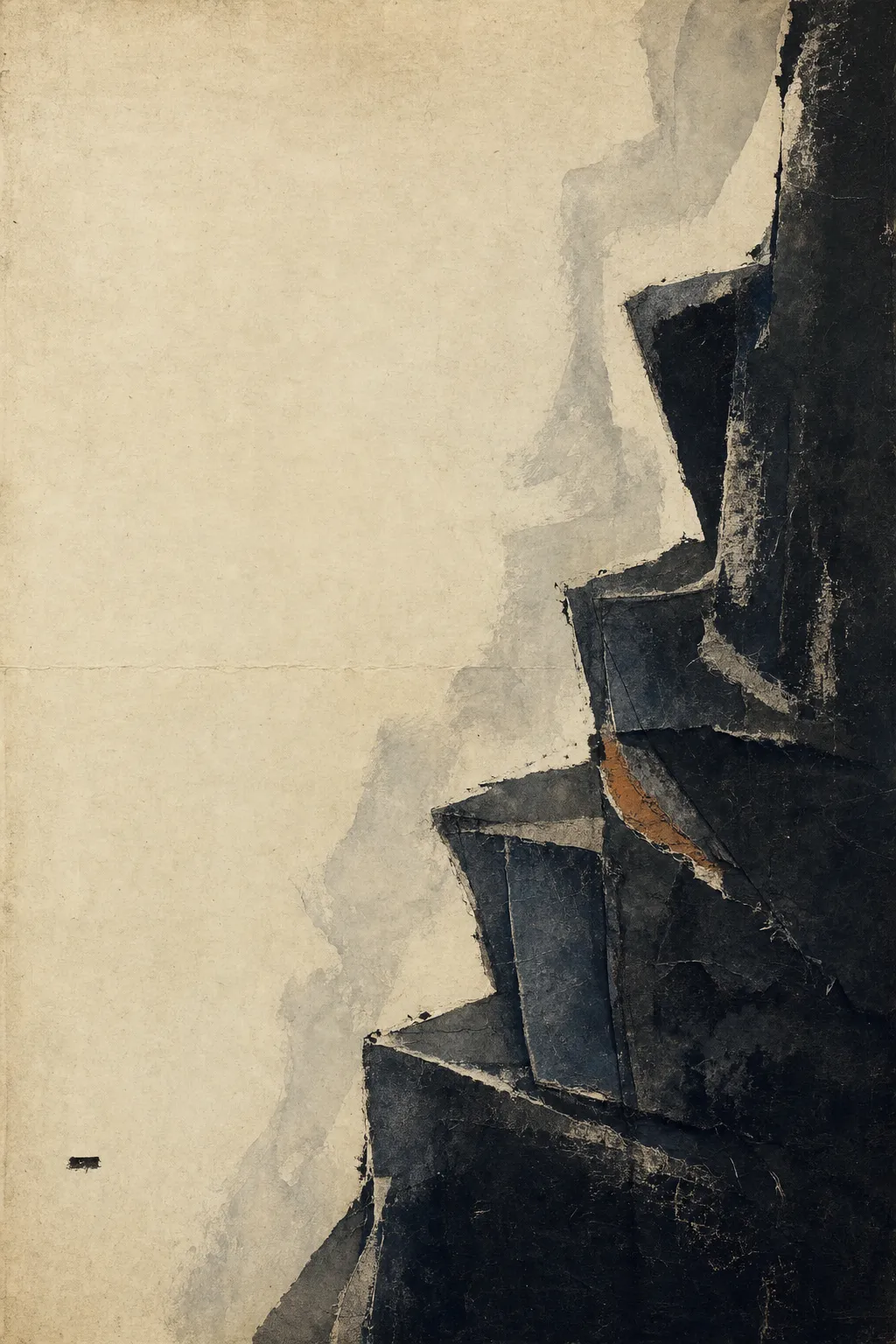
  3. Tall scroll-like sheet. A massed structure of angular carbon-black and indigo paper slabs climbs the right side in hard irregular steps, cropped by the lower and upper edges; one torn seam partway up exposes dull persimmon. Pale gray wash ghosts along its contour and a long channel of bare warm paper fills the left two-thirds, empty except for one tiny black dash floating low on the left.
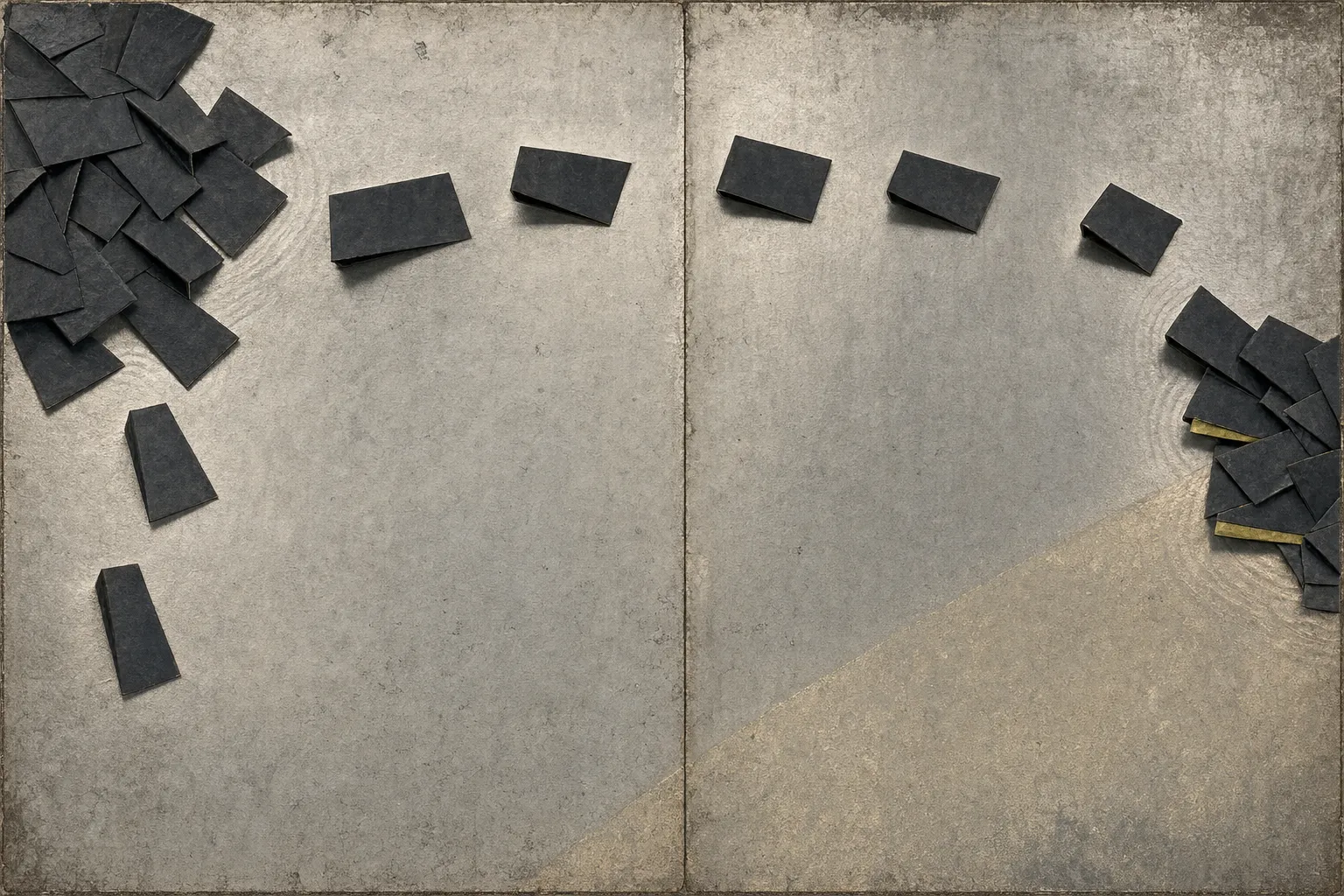
  4. Wide silver-leaf field crossed by faint folding-screen seams. Small matte-charcoal folded paper tabs cluster densely at the upper left, loosen into a widely spaced arc across the top, and compress again at the far right edge, where two tabs show dull citron undersides. The arc breaks before closing; the lower right remains an empty tarnished wedge shading toward gold.
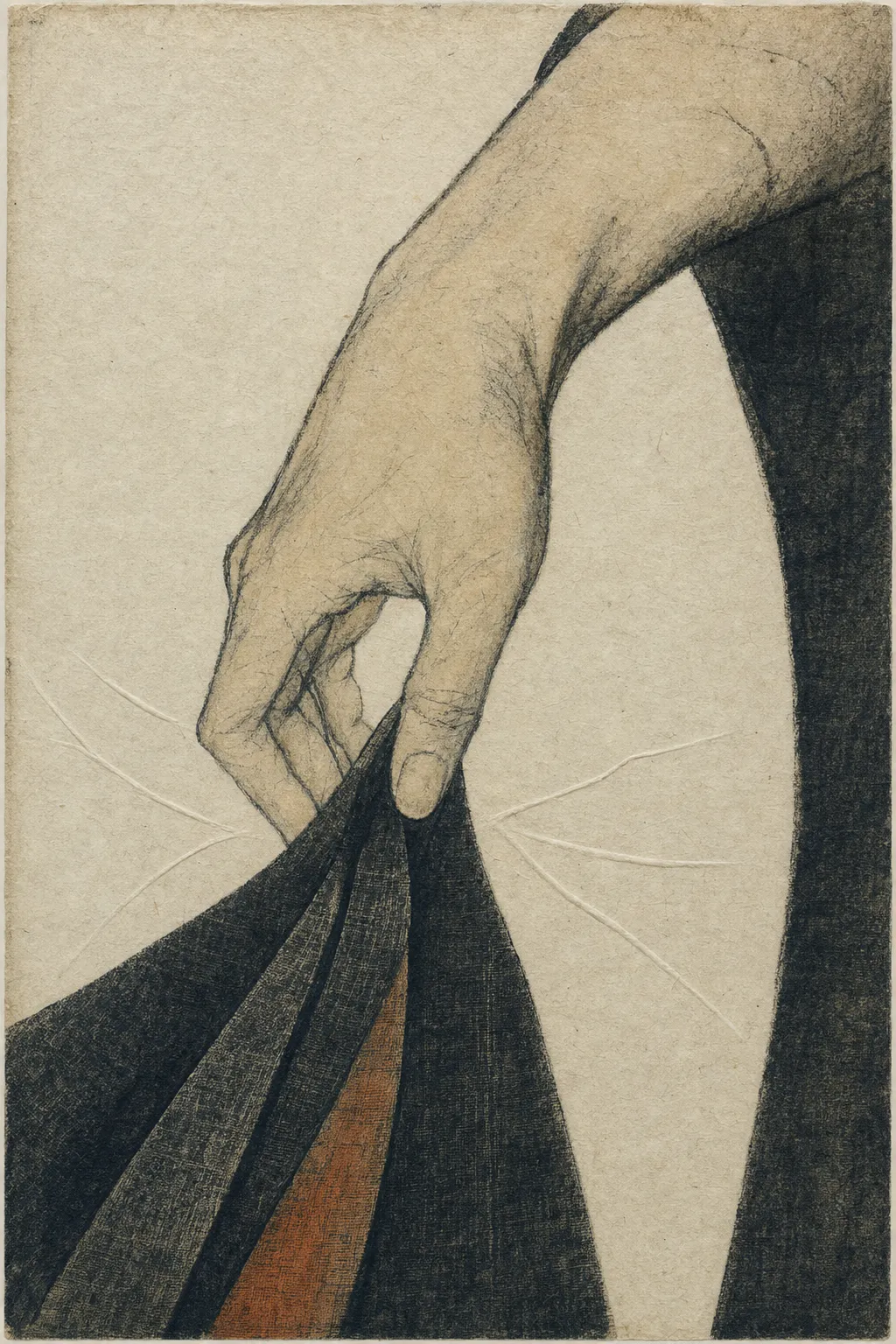
  5. Close-cropped drawing on warm bare paper. A work-worn hand and forearm enter from the upper right, drawn in restrained charcoal with a pale mineral wash; the fingers are open and precise, pinching the edge of a soot-black woven cloth. The cloth fans downward into three broad pleats toward the lower left, one inner fold lined with dull persimmon. Faint embossed crease lines radiate across the otherwise empty paper.
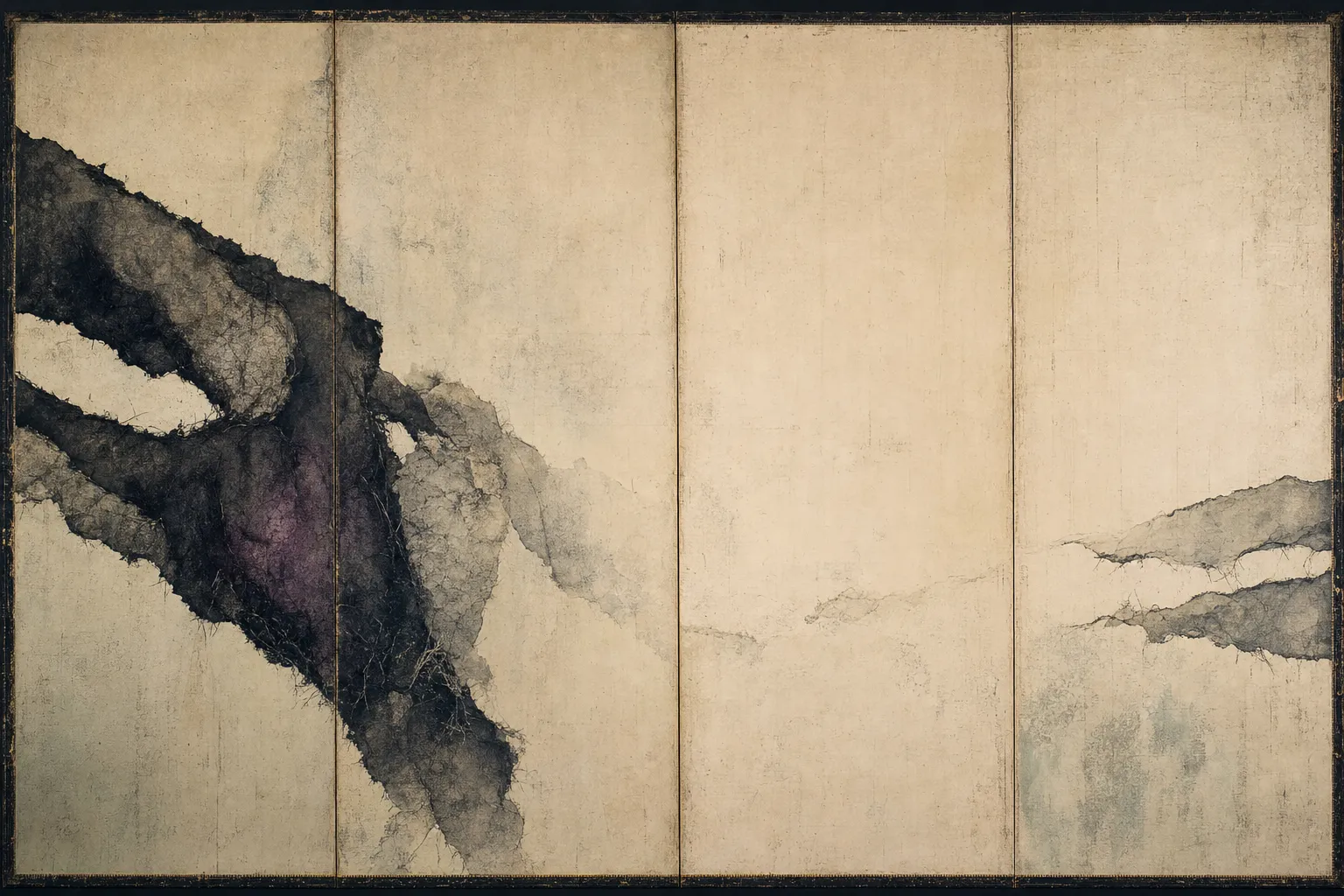
  6. Wide four-panel folding screen in warm aged paper. A charred black fibrous membrane enters at mid-height from the left edge, sags into a dense tangled fold shot with buried aubergine, and thins into ghost-gray wash. The wide center panels stay almost empty and luminous. Near the right edge the membrane returns as two faint torn horizontal folds before leaving the sheet.
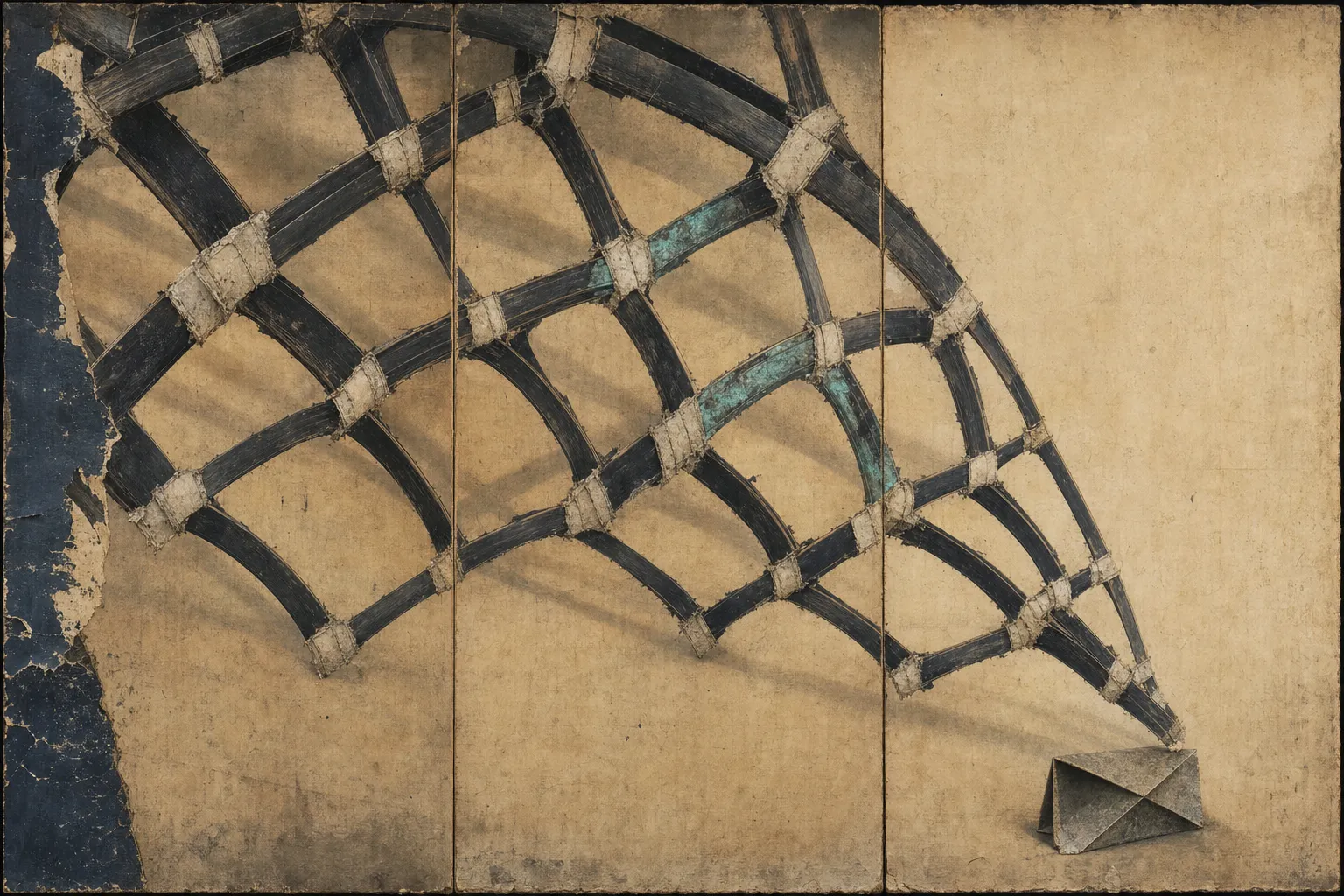
  7. Wide three-panel screen on warm fibrous paper. An immense open lattice of charred black bamboo splints, bound at every crossing with chalked fiber joints, looms from the top and left and curves down across the panels; two inner struts are stained oxidized verdigris, and pale pressure shadows rake beneath it. Its final joint stops just short of a small folded gray-paper brace standing alone near the lower right, with open paper between them. A torn strip of deep indigo runs down the far left edge.
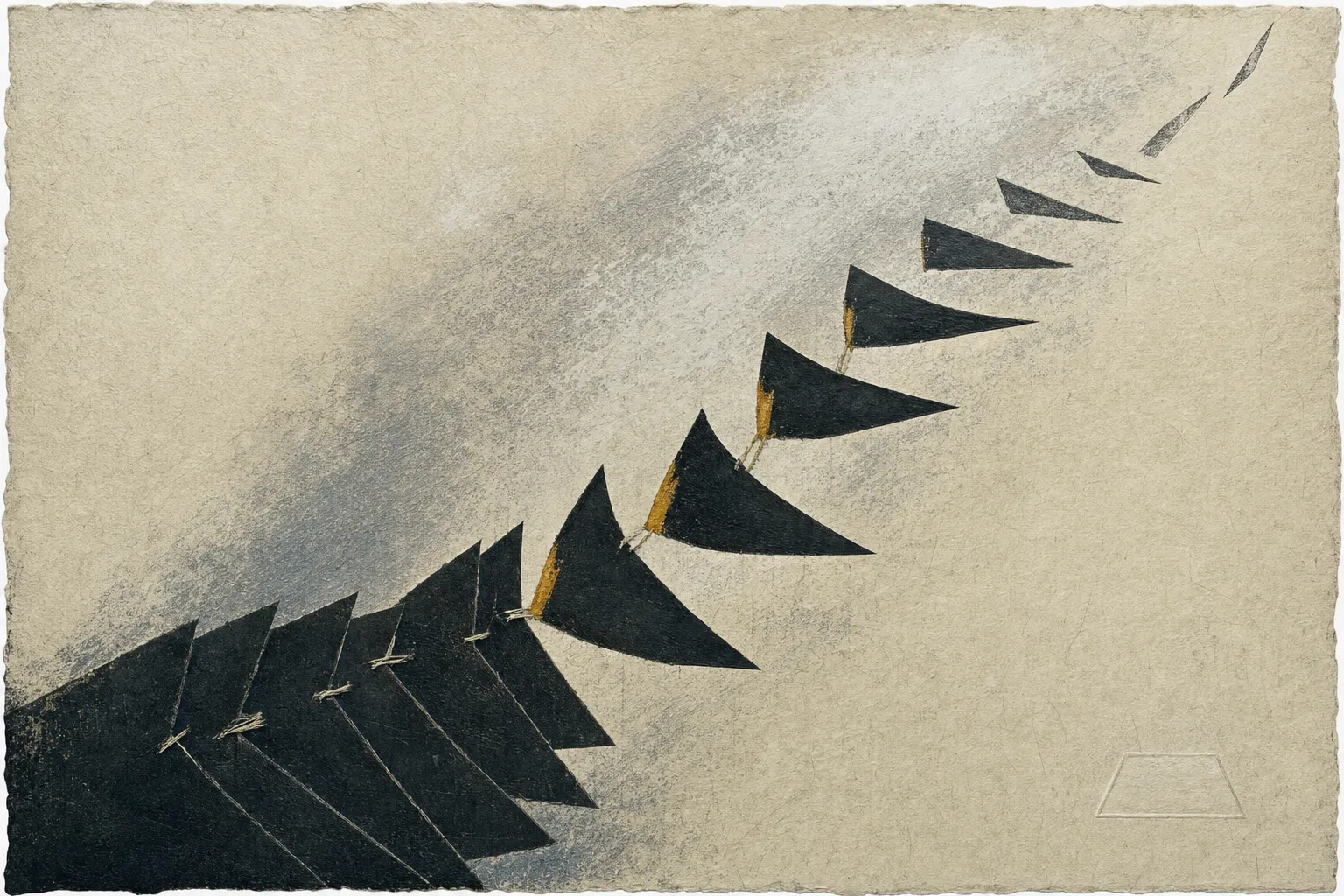
  8. Wide horizontal sheet of warm handmade paper with deckled edges. A connected chain of soot-black triangular paper vanes begins as a dense overlapping bundle at the lower left and rises in a loosening S-curve toward the upper right, each vane rotating further and spaced wider than the last, their fiber hinges flashing dull saffron, until the final slivers leave the frame. A diagonal sweep of rubbed graphite and lifted chalk trails behind the chain, and a small blind-embossed trapezoid rests in the quiet lower right.